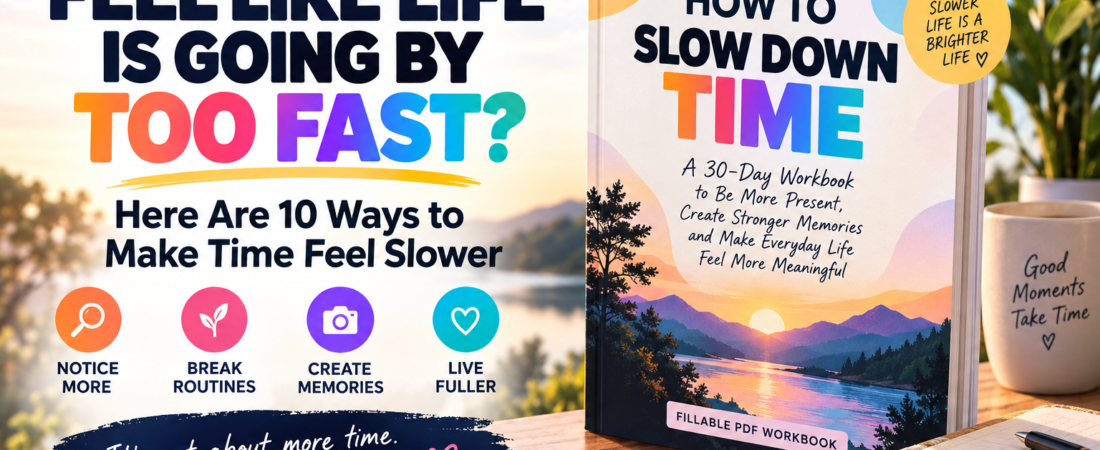
Feel Like Life Is Going By Too Fast? Here Are 10 Ways To Make Time Feel Slower
If your weeks blur together and you keep wondering how another month disappeared, you may not need more hours. You may need more moments that actually register.
See The How To Slow Down Time WorkbookDo You Ever Wonder Where The Time Went?
Have you ever looked at the calendar and wondered how another month disappeared so quickly?
Maybe your weeks seem to blur together. Your weekends feel like they are over almost as soon as they begin. Or you find yourself thinking, “How can it possibly be this time of year again?”
If life feels like it is going by too fast, you are not necessarily looking for more hours in the day.
You may be looking for a way to experience more of the time you already have.
Quick Answer
You cannot literally slow down clock time. But you can become more intentional about your attention, routines, experiences, memory markers, and the way individual days stand apart from one another.
That idea is also the foundation of the How to Slow Down Time fillable PDF workbook , a 49-page downloadable workbook that guides you through a 30-day experiment focused on attention, routine, memory markers, novelty, and meaning.
Why Does Time Seem To Go Faster When Life Becomes Routine?
One reason life can feel fast in retrospect is that similar days can become difficult to distinguish from one another.
Think about an ordinary week. You may wake up around the same time, travel the same route, complete many of the same tasks, visit the same stores, scroll through the same apps, and follow a familiar evening routine.
Now compare that with a vacation, special event, or completely new experience.
You may remember the restaurant you visited, the view from a hotel, a funny conversation, the weather, something unexpected that happened, or a place you had never seen before.
Those experiences create distinct reference points in memory.
The goal is not to turn every Tuesday into a vacation.
It is to create more moments that register.
You may need more moments that feel like they actually happened.
10 Practical Ways To Make Everyday Life Feel Slower And More Memorable
1. Notice One Thing You Normally Ignore
Look closely at something familiar. Notice the way morning light enters the room, the sound of birds outside, the smell of your coffee, the details of a building you pass every day, or the expression on someone’s face during a conversation.
The purpose is simple: give your attention somewhere it usually does not go.
2. Change One Small Part Of Your Routine
You do not need a dramatic life change. Take a different route home. Sit somewhere different for lunch. Try a new coffee shop. Walk in a neighborhood you have never explored.
Small changes can help one day become more distinguishable from another.
3. Stop Multitasking For A Few Minutes
Try eating without scrolling, walking without checking your phone, or having a conversation without doing something else at the same time.
Giving one experience your full attention can make it feel more substantial than constantly dividing your attention between several things.
4. Create A Memory Marker
A memory marker is something that helps a particular day stand out when you look back on it.
It could be a photo, a journal sentence, a particular meal, a small tradition, a song, a conversation, or something new you tried.
5. Give The Day A Name
Instead of thinking of today as just Wednesday, give it a memorable label.
Maybe it becomes “The Day We Ate Breakfast For Dinner,” “The Rainy Bookstore Day,” or “The Day I Finally Took The Long Walk.”
Naming an experience gives your mind another way to distinguish it later.
6. Try A Small First
New experiences do not have to be expensive or complicated.
Try a food you have never ordered. Visit a nearby park. Learn a small skill. Call someone instead of texting. Try a recipe you have never made.
First experiences naturally give a day an identity.
7. Become A Tourist Near Home
Many of us explore unfamiliar cities more carefully than the places where we actually live.
Search for a nearby walking trail, historic location, bookstore, museum, garden, neighborhood, scenic drive, coffee shop, or local attraction you have never visited.
You do not have to travel far to create novelty.
8. Create Anticipation
Part of experiencing time more fully can happen before an event ever arrives.
Plan something small to look forward to: a favorite dinner, an evening walk, a Saturday outing, a new book, a phone call with someone you love, or a quiet morning without errands.
Anticipation can give a week more shape.
9. Document The Ordinary
Not every memory worth keeping needs to be a milestone.
Photograph your kitchen on a Sunday morning. Write down something funny someone said. Record what your neighborhood looks like this season. Save the ordinary details that will eventually become part of your personal history.
10. Ask Yourself What You Actually Remember
At the end of each week, ask:
- What moments stand out?
- What felt new?
- What did I notice that I normally miss?
- Who did I spend meaningful time with?
- What would I want to remember about this week a year from now?
This simple reflection can help turn a collection of days into a recognizable chapter of life.
A 30-Day Experiment For People Who Feel Like Life Is Flying By
If this feeling is familiar, the How to Slow Down Time Workbook takes these ideas further through a structured 30-day experience.
The downloadable workbook is built around the L.I.F.E. Method:
Look Closely
Notice details and moments you might normally overlook.
Interrupt Autopilot
Introduce small changes that make individual days more distinct.
Form Memory Markers
Create recognizable moments you can more easily remember later.
Engage With Meaning
Give more attention to the people and experiences that matter to you.
The workbook includes 30 daily guided experiments, a time-blur audit, attention exercises, memory-landmark activities, weekly reflections, planning exercises, and a before-and-after memory reflection.
It is a fillable and printable PDF, so you can type directly into compatible PDF software or print it and work through it by hand.
What Is The Before-And-After Memory Exercise?
One of the most useful parts of the workbook is a simple personal comparison.
Before starting the 30-day experience, you list as many distinct moments as you can remember from the previous month without checking your phone, photographs, calendar, texts, or social media.
After completing the 30 days, you repeat the exercise.
Why Do This?
It gives you a personal way to notice whether the month feels more distinguishable when you look back on it.
It is not a clinical memory test and does not guarantee a particular result.
Who Might Enjoy This Workbook?
The workbook may appeal to adults who regularly find themselves saying:
“Life Is Going By Too Fast.”
“Every Week Feels The Same.”
“I Want To Be More Present.”
“My Weekends Disappear.”
“My Days Are Blurring Together.”
“I Want To Remember More Of My Life.”
You can read the complete description and see everything included in the How to Slow Down Time 30-Day Fillable PDF Workbook .
Feel Like Life Is Going By Too Fast?
Try a different approach to the next 30 days. Notice more. Break a few routines. Create stronger memory markers. Spend more attention on what matters.
View The How To Slow Down Time WorkbookFrequently Asked Questions About Making Time Feel Slower
Can You Literally Slow Down Time?
No. Clock time continues at the same rate. The goal is to explore how attention, novelty, meaningful experiences, and memory markers may change the way ordinary life feels while you are living it and when you later look back on it.
Why Do My Weeks Seem To Go By So Fast?
Repetitive routines, distraction, and similar days can make stretches of life feel less distinct in retrospect. Creating more recognizable experiences and deliberately noticing ordinary moments may help individual days stand apart more clearly.
How Can I Make My Life Feel Less Rushed?
Start with small changes rather than trying to redesign your entire life. Give one activity your full attention, remove one unnecessary source of rushing, create something to anticipate, establish a ritual, or deliberately notice details you normally overlook.
What Is A Memory Marker?
A memory marker is a distinct detail, activity, ritual, story, or experience that helps one moment or day stand out from another when you look back on it.
Is How To Slow Down Time A Physical Book?
No. It is a 49-page digital workbook delivered as a downloadable fillable PDF. It can also be printed for personal use.
How Long Is The Program?
The core guided experience lasts 30 days and uses small activities intended to fit into ordinary daily life.
Make More Of Your Life Register
We cannot stop another birthday from arriving. We cannot prevent another season from changing. We cannot add extra hours between Monday and Sunday.
But we can become more deliberate about what happens inside those hours.
We can notice the conversation.
We can take the different road.
We can create the ritual.
We can put the phone down long enough to actually see where we are.
And perhaps, when we look back, life will feel a little less like one long blur and more like a collection of moments we remember living.
Ready to try it? Explore the How to Slow Down Time fillable PDF workbook.